
"coffee rust in Central America"
500 article(s) found

Variety Information and Flavor description of Iron pickup Coffee Bean
For the exchange of professional baristas, please follow the coffee workshop (Wechat official account cafe_style) [Typica] Tibica species closest to the original species. The bean shape is slightly longer, like an elongated egg, known as Arabigo or criollo in Central America. It has a clean citric acid taste, sweet aftertaste, low resistance to leaf rust, not easy to take care of, low seed setting of trees, and long harvest period.

Introduction to the characteristics of the Fine Coffee Flavor Manor in Kenya the Central Dashan area of Nyeri
Kenya has two coffee cherry production seasons a year. The main season is from October to December and the secondary season is from April to June. As a loyal fan of Kenyan coffee, we sugar bean boutique coffee certainly will not miss this delicious coffee. At the end of August, we arrived a new batch of new Kenyan beans in this season, from the Kenyan Gatuya washing station. The washing station was established in 1962 and currently cooperates with about 1.

The difference between the three native species of coffee and the introduction of Arabica and Robusta
Coffee belongs to the evergreen shrub of the genus Rubiaceae, which is centered in the tropics. There are about 6000 species of Rubiaceae belonging to 500 genera. Coffee has always been considered to have certain effects, such as invigorating the stomach, waking up the brain, stopping bleeding, dissipating heat, strengthening the body and so on. There are about 40 species of coffee plants, but the only ones that can produce coffee beans of commercial value are Arabica, Robusta and Libby.

Basic knowledge of Coffee beans (1)
Coffee belongs to the evergreen shrub of the genus Rubiaceae, which is centered in the tropics. There are about 6000 species of Rubiaceae belonging to 500 genera.

Special report on Maraka Dula Coffee at Leandria Manor in Nicaragua
Professional coffee knowledge exchange more coffee bean information please follow the coffee workshop (Wechat official account cafe_style Leandura Manor in Nicaragua Maraka Dula Sun treatment Grade: SHG area: Monzonte,NuevaSegovia Novo Segovia Manor: Finc
Selection of basic Coffee Tree Classification
Arabica Coffee and Variety improvement. What do the so-called families, genera and species of Arabica species mean in biological classification? In terms of biological classification, it is divided into boundary, phylum, class, order, family, genus and species from top to bottom, and the lower part of the species is subdivided into subspecies, varieties and varieties. Arabica coffee is generally thought to originate from the Ethiopian plateau and is widely divided.

A brief introduction to the description of the flavor and flavor characteristics of El Qomolangma boutique coffee beans
Salvadoran coffee ranks side by side with Mexico and Guatemala as producers of Asa and Merdo, and is fighting for the top one or two places in China and the United States with other countries. The highlands of origin are large coffee beans of all sizes, which are fragrant and mild in taste. Like Guatemala and Costa Rica, coffee in El Salvador is graded according to altitude, and the higher the altitude, the better the coffee
A brief introduction to the treatment method of grinding degree and baking degree of El Qomolangma boutique coffee beans
A brief History of Coffee production in 1742, coffee was introduced to El Salvador from the Caribbean (1740). In the mid-19th century, El Salvador's original export pillar Indigo (one of the dyes) received a gradual decline in the development of synthetic dyes in Europe, and coffee gradually became the main export product under the guidance of the government. In 1856, the first 693 bags of coffee beans were shipped to Europe. all long

Introduction to the characteristics of Indonesian Java Coffee Flavor and Flavor Manor
The history of Java coffee (java Java Coffee) the Dutch first introduced coffee to Central and South America in the 1820s. Coffee spread from the Dutch colonies to French Guiana and Brazil. In the process of colonization, the Dutch grew coffee in Malaba, India, and brought it to Bada in what is now Java, Indonesia, in 1699.
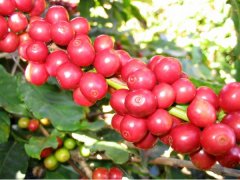
Coffee crisis with tricky tastes and fragile varieties
The price of coffee is forecast to rise by 25% by 2050. The livelihoods of 25 million people may depend on whether scientists can find a way to protect fragile coffee plants and berries. A whole year's coffee harvest may depend on the florescence of just a few days, when plants are particularly vulnerable to extreme weather. Last year, coffee leaf rust caused coffee farms in Nicaragua

The relationship between coffee bean quality and altitude, the relationship between air temperature, and the harm of climate change to coffee trees.
Professional coffee knowledge exchange more coffee bean information please follow the coffee workshop (Wechat official account cafe_style) altitude: a symbol of coffee quality? Higher altitude is often associated with better sweetness and more complex coffee flavor; to be exact, there is a correlation between the two, but not causality. To a large extent, the factors that affect the quality of coffee

Overall soft Salvadoran Himalayan coffee flavor manor features boutique coffee beans
The national emblem of El Salvador was used on September 15, 1912. The national emblem is an equilateral triangle whose three yellow lines represent equality, truth and justice. Five volcanoes rise between the Pacific Ocean and the Atlantic Ocean, symbolizing the five countries in Central America. The pole of freedom and the red cap of freedom stand high on the top of the mountain, radiating the light of freedom and liberation. Jin Guangzhong is sa on September 15, 1821.
Coffee beans from El Salvador
Area: 210.41 million square kilometers Climate: tropical climate, temperature varies slightly with altitude; May to November rainfall is greater Capital: San Salvador (San Salvador) language: Spanish; other: Indian dialect currency: Colon [country profile]: El Salvador is the largest in Central America.

Arabica mutant iron skin card raw bean, how to taste blue mountain, Yunnan small grain iron skin card kind flavor
For professional baristas, please follow the coffee workshop (Wechat official account cafe_style) Arabica species (scientific name CoffeeArabica). The origin of Arabica species is Ethiopia's Abyssinia Plateau (present-day Ethiopian Plateau). In the early days, it was mainly used as medicine, and the habit of baking and drinking was developed in the 13th century.

A brief introduction to the Origin, Development, History and Culture of El Salvador Himalayan Fine Coffee beans
The current situation of coffee production is a natural and man-made disaster, which is a perfect description of the challenges facing the coffee industry in El Salvador. Despite getting rid of the haze of war, El Salvador's coffee production still faces challenges from time to time, including: 1998, hurricanes; 2001, earthquakes; 2002, volcanic eruptions; 2012, leaf rust

How about Arabica coffee? Arabica coffee flavor
Following Cafe Review (Wechat official account vdailycom) found that Arabica beans, which opened a small shop in Beautiful Cafe, was an important kind of commercial coffee, resulting in a period of less than three years, with a high-quality aroma and sour taste. Arabica coffee beans are mainly produced in South America (except parts of Argentina and Brazil), Central America, Africa (Kenya, Ethiopia and other places), mainly in the east.

A brief introduction to the cultivation of boutique coffee beans on Mount Everest in El Salvador, geographical location, climate and altitude
A brief History of Coffee production in 1742, coffee was introduced to El Salvador from the Caribbean (1740). In the mid-19th century, El Salvador's original export pillar Indigo (one of the dyes) received a gradual decline in the development of synthetic dyes in Europe, and coffee gradually became the main export product under the guidance of the government. In 1856, the first 693 bags of coffee beans were shipped to Europe. all long

A brief introduction to the treatment method of grinding degree and baking degree of fragrant and pure El Qomolangma coffee beans
Salvadoran coffee ranks side by side with Mexico and Guatemala as producers of Asa and Merdo, and is fighting for the top one or two places in China and the United States with other countries. The highlands of origin are large coffee beans of all sizes, which are fragrant and mild in taste. Like Guatemala and Costa Rica, coffee in El Salvador is graded according to altitude, and the higher the altitude, the better the coffee
Analysis of Ethiopian Beans and Distinction between Characteristic Flavor and Growing Environment
Professional barista exchanges, please pay attention to coffee workshop (Weixin Official Accounts cafe_style) Ethiopia related recommendations Sidamo Guji sun IMPCT public welfare joint light baking, fruity, berry aroma, around the nose sweet and sour, all the proceeds donated to IMPCT social cause preschool education fund Ye Jia Xue Fei Hai La Si Ke Chi sun light baking, lemon, citrus, tea, roasted sweet potato, this

A brief introduction to the treatment method of grinding degree and baking degree of El Qomolangma boutique coffee beans
Coffee production in El Salvador was once affected by domestic political instability. In 1992, the parties signed a peace agreement and the civil war was suspended. The coffee industry began to recover. The present situation of coffee production is a natural and man-made disaster with an ill-fated fate. It is more appropriate to describe the challenges facing the coffee industry in El Salvador. Although it has got rid of the haze of war, El Salvador's coffee production still faces challenges from time to time.